


Comparison Between AINOPOL PON All-Optical Network and Ethernet All-Optical Network
2026-07-03 18:19:46
241
Comparison Between AINOPOL PON All-Optical Network and Ethernet All-Optical NetworkSelection Guide for Industrial Park Network Renovation
Currently, there are two mainstream optical fiber solutions for digital transformation of industrial parks and manufacturing factories: passive PON all-optical network and Ethernet all-optical network. Many park IT staff and engineering contractors fail to distinguish their core differences in transmission distance, equipment room occupation, wiring cost, long-term energy consumption, expansion capacity and multi-service linkage. Blind selection leads to low upfront investment yet skyrocketing expenses on later operation & maintenance, capacity expansion and electricity bills.
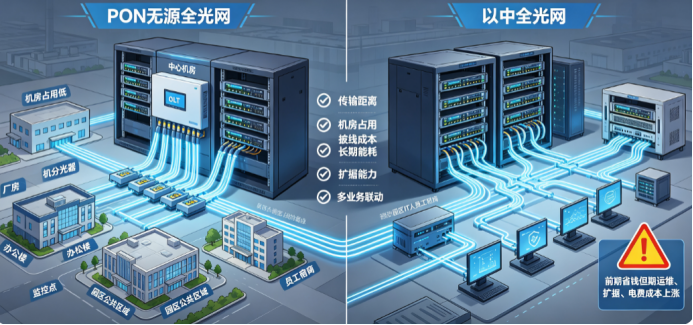
Based on official solution data of AINOPOL, this article conducts an all-round horizontal comparison of the two technologies, defines clear application scenarios, and provides measured cost calculation to help parks and factories quickly select the optimal all-optical renovation solution. The whole content centers on comparison of two solutions and selection criteria for industrial parks.
I. Core Differences Between Two Basic All-Optical Architectures
1. AINOPOL Passive PON All-Optical Architecture
It adopts a two-layer flattened point-to-multipoint structure consisting of core-room OLT, passive ODN optical distribution network and photoelectric integrated ONU/AP terminals.
Only passive optical splitters are deployed on each floor without any active power-consuming devices. One main optical fiber can cover dozens of terminals via 1:16 / 1:32 optical splitting. Single-mode optical fibers support non-relay transmission up to 20km, eliminating the need for floor weak-current equipment rooms.
The integrated OLT is embedded with full functions including AC wireless control, VOIP voice service, SD-WAN interconnection, CVR centralized monitoring, firewall and IPS defense. A single optical fiber carries multiple services such as office data, security monitoring, corporate telephones, access control and public broadcasting.
2. Traditional Ethernet All-Optical Network Architecture
It is a three-layer active structure composed of core fiber switches, floor aggregation fiber switches and fiber access terminals, adopting point-to-point dedicated optical fiber links where one optical fiber serves only one single terminal.
All floor switches need 24-hour continuous power supply and heat dissipation with a maximum transmission distance of merely 2km. Additional intermediate active equipment rooms are required for longer coverage. Such switches only support basic data transmission, while voice, monitoring and access control systems need independent servers, resulting in isolated systems without native linkage functions.
II. Detailed Comparison in Seven Dimensions
Dimension 1: Transmission Distance (Key Dividing Line for Large-Scale Factory Zones)
PON All-Optical: Single-mode fiber realizes 20km non-relay transmission. No intermediate equipment rooms are needed for large industrial parks, remote warehouses, branch factories and outdoor material yards, perfectly fitting scattered factory areas over 10,000 square meters.
Ethernet All-Optical: The maximum point-to-point transmission distance is 2km. Additional floor fiber switches together with supporting power supply, equipment rooms and cabinets are mandatory beyond this range, doubling potential fault points.
Selection Tip: Prioritize PON solution for large parks with remote warehouses and branch factories.
Dimension 2: Equipment Room Occupation & Energy Consumption
PON All-Optical: Compact passive splitters require no power supply or cabinets, leaving zero active devices in weak-current rooms. The total number of equipment room devices is reduced by 80%, occupying only 1/7 space of traditional solutions and cutting overall weak-current energy consumption by 70%.
Ethernet All-Optical: Fiber aggregation switches are deployed in every building and each floor with densely arranged cabinets. Cooling air conditioners are essential for floor weak-current rooms. Massive devices operating round the clock lead to over 3 times higher power consumption than PON solutions.
Selection Tip: Choose PON for parks with limited equipment room space and demands for long-term electricity saving and energy-saving policy compliance.
Dimension 3: Wiring Materials & Construction Labor Costs
PON All-Optical: Massive terminals are covered via optical splitting from one main fiber. According to official calculation data of 15-story office buildings, the total weight of horizontal wiring is only 135kg, far lower than 3570kg of traditional network cabling, cutting material consumption by 70%. Matched pre-connected POF photoelectric composite cables eliminate on-site fiber splicing, enabling simple plug-and-play installation by ordinary workers and shortening construction period by 60%.
Ethernet All-Optical: Independent point-to-point fiber laying requires huge quantities of main optical fibers, causing congested cable trays. Material and labor costs are doubled with extra expenses on trenching and road restoration.
Selection Tip: PON is preferred for multi-story industrial parks with over 800 working stations and clustered buildings.
Dimension 4: Smooth Bandwidth Expansion Capacity
PON All-Optical: All existing passive ODN links can be fully reused. Upgrades from GPON to 10GPON, 40G PON and 100G PON need no rewiring, only replacing core-room OLT devices to complete 10-gigabit network renovation. No pipeline reconstruction is needed within the 30-year service life of optical fibers.
Ethernet All-Optical: Full replacement of all core and floor fiber switches is required for bandwidth upgrading, resulting in complete elimination of original active devices and repeated hardware investment every 3 to 5 years with high long-term TCO.
Selection Tip: Select PON for parks with continuous investment attraction & expansion plans and demands for high-bandwidth services such as cloud desktops and 3D simulation.
Dimension 5: Equipment Failure Rate & O&M Difficulty
PON All-Optical: Optical splitters contain no electronic components, free from heat generation and aging faults, lowering overall equipment failure rate by 60%. The EAAS cloud platform supports visualized one-screen management, enabling staff to distinguish fiber faults and power faults within 10 seconds. Remote maintenance via mobile APPs is available even without full-time IT technicians.
Ethernet All-Optical: Overlapped multi-layer active switches are equipped with independent management interfaces. Troubleshooting requires one-by-one inspection floor by floor. Disputes among different device suppliers further push up labor costs for daily operation & maintenance.
Selection Tip: PON is ideal for scattered multi-building parks without dedicated IT management staff.
Dimension 6: Multi-Service Integration (Office / Monitoring / Telephone / Access Control & Broadcasting)
PON All-Optical: The integrated OLT natively integrates IPPBX corporate telephone systems, CVR centralized monitoring and access control broadcasting linkage functions. One set of optical network realizes integrated scheduling without purchasing extra independent service servers.
Ethernet All-Optical: Switches only transmit pure data. Voice, security monitoring and scheduling systems have to be deployed separately with isolated management platforms, bringing extra hardware procurement expenses.
Dimension 7: Short-Term Hardware Investment for Single Independent Buildings
PON All-Optical: Slightly higher upfront OLT investment for single office buildings with less than 100 terminals.
Ethernet All-Optical: Lower short-term switch procurement cost for small-scale short-distance buildings within 100 terminal points.
III. Clear Selection Criteria for Industrial Park Renovation
Scenario 1: Prioritize AINOPOL PON All-Optical Network
Total factory area exceeds 5,000 square meters with remote warehouses, branch factories and outdoor terminals over 2km away from core equipment rooms;
The park consists of no less than 3 buildings with over 500 working stations and long-term expansion plans;
Demand for integrated scheduling covering office networking, 4K monitoring, corporate IP telephones and public broadcasting via one unified network;
Limited space for equipment rooms and floor weak-current rooms, with demands for electricity cost reduction and energy-saving transformation policy compliance;
No full-time professional network engineers on site, requiring one-click visualized remote cloud operation & maintenance;
Large scattered application scenarios including mechanical processing, logistics warehousing and multi-base manufacturing.
Scenario 2: Adopt Ethernet All-Optical Network
Independent small office buildings with no more than 100 working stations and all terminals within 2km from equipment rooms;
Only basic office internet access required without demands for unified monitoring, corporate telephone systems and park-wide scheduling;
No expansion or bandwidth upgrading plans within 3 years, focusing merely on minimizing short-term hardware procurement costs.
There is no absolute superiority or inferiority between passive PON all-optical networks and active Ethernet fiber networks. Selection decisions should not be made only based on upfront hardware quotations, but take 5-to-10-year total cost of ownership into full consideration covering transmission distance, equipment room energy consumption, wiring construction, long-term expansion, multi-service integration and human resource input for operation & maintenance.
For large-scale multi-building industrial parks, manufacturing factories and logistics warehouses, AINOPOL PON photoelectric integrated all-optical networks show outstanding advantages in long-distance coverage, energy saving, fault reduction, integrated scheduling and smooth technical iteration, with long-term TCO only accounting for 47.43% of traditional solutions. Ethernet all-optical networks are only suitable for short-term deployment in small independent buildings. Park network renovation shall focus on long-term digital development and give priority to passive PON solutions to realize one-time wiring free from repeated reconstruction within 30 years.
IV. Frequently Asked Industry Questions
Q1: PON adopts shared bandwidth via optical splitting, will 8K monitoring services lag when multiple enterprises run simultaneously?
A: AINOPOL integrated OLT is equipped with refined QoS scheduling engine and built-in recognition library supporting over 3000 types of applications. Independent bandwidth guarantee is provided for monitoring, video conferences and industrial control services. Each PON port supports maximum 10-gigabit bandwidth with dynamic bandwidth allocation after optical splitting, effectively avoiding bandwidth contention and stuttering. Priority can be assigned to core services with one single click.
Q2: Is Ethernet more cost-effective for small factories with few terminals?
A: Ethernet solutions have lower short-term hardware costs within 100 terminals, yet annual electricity expenses, later expansion fees and equipment replacement costs keep rising year by year. PON solutions deliver lower comprehensive costs in cycles longer than 5 years. Ethernet is acceptable if no expansion demand exists in the short run.
Q3: Are optical fibers mutually compatible between the two solutions and can they be switched to each other later?
A: Optical fiber media are universal in essence, while matched optical splitters, OLT/fiber switches and terminal communication protocols are incompatible. Core equipment in equipment rooms and floor transmission supporting devices need to be replaced for mutual solution switching.
Related Articles


